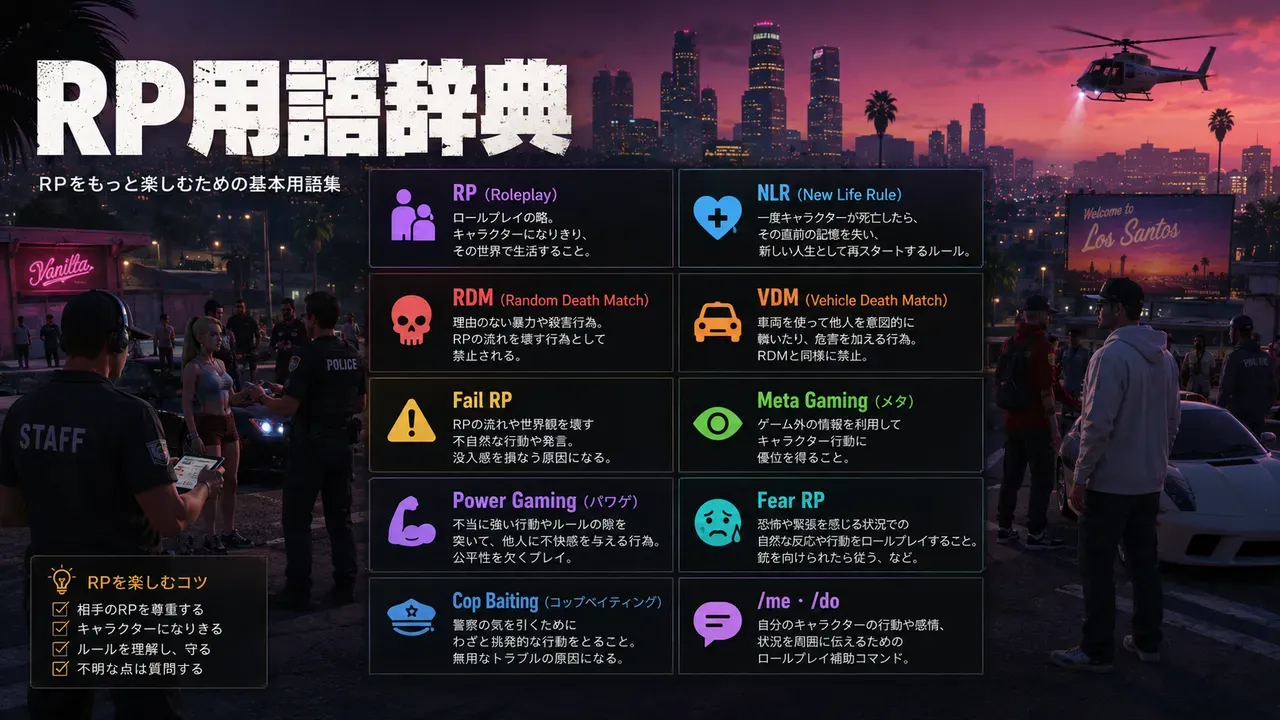
GTARP (GTA Roleplay) has many of its own terms and abbreviations. Server rule pages and Discord notices are often written on the premise of these terms, and joining without knowing their meanings can lead to rule violations.

In this article, based on major English-speaking glossaries and the expressions used in Japan's streamer-server culture, GTA6 FEED has organized the essential terms into groups of meaning, with the goal of helping beginners read server rules on their own.

Note that the definitions shown here are the general ones shared across GTARP as a whole, but the fine handling differs by server and by country. You do not need to memorize every term perfectly before joining. Once you have the basics down, the fastest route is to actually enter a server and learn while being taught by the people in the city. Ultimately, the basic premise is to follow the rules of the server you join (the "roppou") and the guidance of that city's residents.

[Image blocked: The RP glossary summarizing the basic terms commonly used in GTARP]

The 10 Words Beginners Should Learn First

Before starting GTARP, you only need these 10 words to begin with. The rest you can learn as you play.

TermRough Meaning
RPPlaying while fully acting as a character
MetaUsing information your character could not know
RDMAttacking/killing others without reason
VDMRunning people over with a vehicle without reason
Power PlayOne-sided RP that strips away the other's choices
Meisou (meditation)A euphemism for restarting the game or client
Yugami (distortion)A euphemism for bugs/glitches
Kokoronaki (heartless)A euphemism for NPCs (mob residents)
RoppouThe official rules of that server
BANBeing expelled from the server

1. Basic Concepts — Start Here First

RP (Roleplay)

The act of role-playing. It refers to the general behavior of a player fully becoming an in-game character, living in the city as that person, and interacting with others. In GTARP, the basic stance is not to "beat" the game but to "act" as a single resident.

IC (In-Character)

Refers to speech, information, and events as the character. What the character experiences in-game is IC knowledge, and RP proceeds within this IC world.

OOC (Out-of-Character)

Refers to speech and information from outside the character, that is, as the person behind the screen (the player themselves). Exchanges on Discord, streams, and dedicated OOC chat are OOC. Not confusing IC and OOC is a fundamental piece of RP etiquette.

Character Creation

The work of crafting the appearance, name, and setting (background, personality, occupation, etc.) of the character you play. It is the starting point of RP.

Immersion

The state in which the place feels as if it were a real world. Many of GTARP's rules exist to avoid breaking this immersion.

Kansokusha (Observer)

A way of referring to viewers, used in Japan's streamer-server culture. Rather than entering the city as a player, it refers to the position of "observing" the city's events through streams.

2. Prohibited / Trouble Terms — Terms That Easily Become Rule Violations

The terms in this category are important ones that can lead to a kick or BAN if violated. Because the fine details of the definitions differ by server, please be sure to check each server's rules.

RDM (Random Death Match)

Short for Random Death Match. The act of attacking or killing other players without a legitimate RP reason or lead-up. Because GTARP demands a narrative context even for violence, suddenly shooting someone is considered a serious violation.

VDM (Vehicle Death Match)

Short for Vehicle Death Match. The act of using a vehicle as a weapon to run over or kill other players without reason. It is the vehicle version of RDM and is subject to kicks or BANs on many servers.

Meta / Meta Comments (Metagaming)

The act of bringing OOC information your character could not originally know into IC actions. For example, heading as your character to a location you learned from a stream, another viewpoint, or Discord. Because it fundamentally breaks the fairness of RP, it is one of the most disliked violations.

Shiji Comments / Shiji-chu (Instruction Comments)

A term specific to Japan's streaming culture referring to the act of viewers giving streamers specific instructions in the comments, and to the people who do so. Comments like "talk to that person" or "go to X and you'll meet them" induce meta and break RP, so they are clearly prohibited on many servers and streams. Stgra's official rules also list such instruction comments as a prohibited item.

Hato / Hato Comments (Pigeon)

Refers to the act of conveying, in the comments, information seen on another stream or viewpoint to a different streamer. Comments like "X is heading your way right now" or "they said this behind the scenes" are examples. Because they carry information that could not originally be known within RP, they easily cause meta and ghosting, and like instruction comments they are prohibited on many streams.

Okimochi (Feelings)

Refers to viewers sending excessive opinions, lectures, or criticism about the actions of a streamer or character. It is sent not only in the comments but also via social media or DMs. RP is a story created among participants, and when observers intervene excessively from the outside, it becomes a cause of hindering players' free roleplay.

Power Play (Power Gaming)

The act of one-sidedly forcing actions without giving the other party room to react or counter. Or the act of unrealistically abusing the game's mechanics to advantage only oneself. RP is about creating a story together, and behavior that strips away the other's choices is considered a violation.

NLR (New Life Rule)

Short for New Life Rule. The rule that when a character dies (a case of fully dying without being revived), they lose their memories from before and after the death, and do not immediately return to the death scene or take revenge over the incident. How to distinguish a down (temporary incapacitation) from full death differs by server.

Character Break (Kyara-bure)

Inconsistent behavior that ignores the setting or personality of the character being played. This includes cases where the person behind the screen unintentionally slips out.

Kantsuu RP (Penetration RP)

When the emotions of the person behind the screen (the player themselves) "penetrate" through and surface in the character's speech and actions. It is used especially in scenes where raw OOC emotions like anger or discomfort leak into IC exchanges. It is close to character break, but the emphasis is less on a mismatch with the setting and more on the person's own emotions coming out.

Ghosting

The act of watching another player's live stream or alternate viewpoint and using the information gained there to pinpoint the other's location, corner them, or gain an unfair advantage. In English-speaking circles it is also called stream sniping, but in Japan's GTARP community it is generally called "ghosting" or "ghost." It is a kind of meta and is strictly prohibited.

CK (Character Kill)

Short for Character Kill. Refers to the permanent death of a character. A CK'd character often can never be used again, and it is generally treated as a heavy matter involving the operators' approval or agreement among the parties.

PK (Player Kill)

Short for Player Kill. Rather than a permanent character deletion like a CK, it refers to a temporary handling. However, the specifics differ by server: it may refer to a temporary death/defeat, or it may be treated as involving memory processing from before and after the death.

3. Command / System Terms — In-Game Mechanisms

Meisou (Meditation)

A euphemism for restarting the game or client without breaking the RP worldview. When you need to close the game due to a glitch or poor performance, having the character "meditate" lets you leave and return while keeping the immersion of the scene. Such euphemisms differ by server and community.

Yugami (Distortion)

A euphemism for bugs and glitches without breaking the RP worldview. By describing a situation where behavior went wrong or processing got disrupted as "a distortion occurred," you can address the glitch while keeping immersion. Like meisou, such euphemisms differ by server and community.

Kokoronaki (Heartless)

A euphemism referring to the NPCs that originally exist in the city (mob residents who are not players). They are called this to distinguish them from residents who are played with intent. This too is an expression for maintaining the worldview, and the term varies by city.

Kokoro no Me (Mind's Eye)

A euphemism referring to the left Alt key. On many servers, while you hold left Alt, the names and IDs of nearby players are displayed. Used like "look with the mind's eye," it expresses the action of checking the other person's name with this function while keeping the worldview. What is displayed and whether it is supported differ by server.

Eisei (Satellite)

A euphemism referring to the stream/broadcast itself. It is used to avoid breaking the immersion of the RP world. "The satellite is on" can indicate that a stream is live.

Nodo (Throat)

A euphemism referring to the microphone or voice condition. "My throat is in bad shape" is used to convey a mic problem or difficulty speaking while keeping the RP worldview.

Kishou / Shushin (Waking / Sleeping)

Euphemisms where logging into the server is called "waking" and logging out is called "sleeping." They are used to maintain a sense of life within the city.

Kyousei Meisou (Forced Meditation)

Refers to a state where all participants need to log out and reconnect once, due to a server's scheduled restart or the like. In contrast to "meisou," which refers to an individual restart or relog, forced meisou differs in that it occurs due to the server's circumstances.

Yume no Sekai (Dream World)

A euphemism referring to OOC, that is, the real side / outside the character. Within a worldview that treats the IC city as "reality," the reality outside the game is sometimes expressed as the "dream world."

Down

A state of having lost health and become incapacitated. On many servers, at this point it is not yet "death," and you can be revived by EMS rescue. The distinction between full death and a down is an important concept that also relates to the NLR mentioned earlier.

EMS

Short for Emergency Medical Services. Refers to players who play paramedics/medical workers, or that occupation. They handle the transport and treatment of the injured.

PD / LSPD

PD is short for Police Department, and LSPD is short for Los Santos Police Department. It refers to the police of Los Santos, GTA's setting, and this naming is established on Japanese servers as well. It is the role on the side maintaining public order, and paired with crime-side roles, it drives the city's story.

Whitelist (WL)

A system where only those who pass an application or screening can participate. Unlike public servers anyone can enter, by limiting participation to those who understand the rules, the aim is to maintain RP quality and server order.

4. Server / Community Terms — Japan's GTARP Culture

Saba (Server)

Means server. In Japanese communities, "server" is often written and called "saba."

Suto-saba

Short for streamer server. Refers to servers structured and operated centered on streamers. They tend to generate large excitement that draws in viewers.

Nora (Stray)

Refers to a state where strangers gather, or a public server anyone can join. Used like "play in nora."

Miuchi / Miuchi-saba (Inner Circle)

Refers to a closed relationship or server gathering only acquaintances and companions. It is used as the opposite of nora.

Stgra

"Street Graffiti Roleplay," commonly known as Stgra. One of the large roleplay projects operated by Shobosuke that became the trigger for Japan's GTARP culture to become widely known. With many streamers, VTubers, and notable figures participating, it has strongly driven GTARP's popularity in Japan. Viewers are called "kansokusha (observers)."

VCR GTA

A large invitation-only, limited-period GTARP event hosted by VAULTROOM and Crazy Raccoon. Unlike the always-running Stgra, it is characterized by being held within a set period.

Roppou (Six Codes)

A term used in Japan's GTARP scene referring to the document compiling that server's official rules. Participants are required to read and observe it. Many servers ask that you avoid bringing up the roppou itself during RP (behavior that uses the rules as a shield). Because the contents differ greatly by server, you should be sure to read through it before joining.

Shi / Seifu / Shichou (City / Government / Mayor)

Euphemisms for the server's operators/administrators, adapted to the RP worldview. As entities that decide the city's systems and policies, they are called "city," "government," "mayor," and the like. The naming and expression of roles differ by server.

BAN / Kick

A BAN is expulsion from the server (often permanent), and a kick is a temporary forced exit. They are used as measures against serious violations such as RDM, VDM, and meta.

On the Certainty of the Terms

Among the terms in this article, the definitions of prohibited-act terms such as RDM, VDM, meta, power play, NLR, CK, and PK are high-certainty ones that can be confirmed in common across multiple independent glossaries and various servers' rules. However, the distinction between a down and death, the conditions for applying CK, and so on differ greatly by server and country. It is not uncommon for the same word to have slightly different interpretations from city to city. This article is strictly a first foundation; when you encounter a word you do not understand or a local rule, asking that city's residents is the most reliable approach.

Incidentally, English-speaking RP servers also use terms like Fail RP, Fear RP, /me, and /do, but these are not necessarily common in Japan's GTARP culture. For that reason, this article focuses on terms that beginners are likely to actually encounter on domestic servers and in streaming culture.

Disclaimer

This article is an explanatory piece researched and organized by GTA6 FEED based on various publicly available information, and it has no relationship whatsoever with Rockstar Games or Take-Two Interactive, or with the operators of the various servers and projects mentioned. The definitions and operation of terms differ by server and community and may change over time. For the latest and accurate rules, please check the official information of each server you join.